Refrigerator Repair
One Boat, One Chance: Parts-Complete Sub-Zero Service on Bainbridge Island
Every part not already on the van costs a round trip on the busiest route Washington State Ferries runs, so a Bainbridge Sub-Zero visit is planned to finish in one crossing: a full diagnosis before anything is ordered, likely companion parts packed, island calls grouped onto one sailing.
Seattle-Bainbridge carried 4.9 million passengers and 1.6 million vehicles in 2024, and 2.1 million of those passengers walked on, which makes it the busiest route Washington State Ferries operates. Every service call on this island sits on the far side of that number, and it changes how the work has to be planned long before anyone opens a cabinet.
The island belief that gets it backwards
The common belief is that island repairs run long because parts are slow to reach the island. The part is rarely the hold-up. What costs the time is a technician standing in a Winslow kitchen holding the wrong part, with the right one on the other side of the water.
Two Jumbo Mark II boats work this crossing, each rated for 2,499 passengers and 202 vehicles, and the sailing itself takes thirty to thirty-five minutes. The sailing is not the obstacle. The vehicle line at a busy sailing is. A forgotten filter-drier or the wrong gasket profile is not a twenty-minute errand here. It is most of a working day, and it lands on whoever was booked behind you.
Winslow, Rolling Bay, Lynwood Center and Port Madison all sit behind the same sailing. So the standard we work to is not the mainland standard. It is: leave the house with the fault fully identified and the parts list closed.
What is actually happening
The faults themselves are ordinary. What is unusual is the penalty for guessing at them. A full-size built-in Sub-Zero usually has two independent sealed systems in one cabinet, and the great majority of calls resolve into four families: airflow and defrost, condenser heat rejection, controls and sensors, or a real loss in the sealed system.
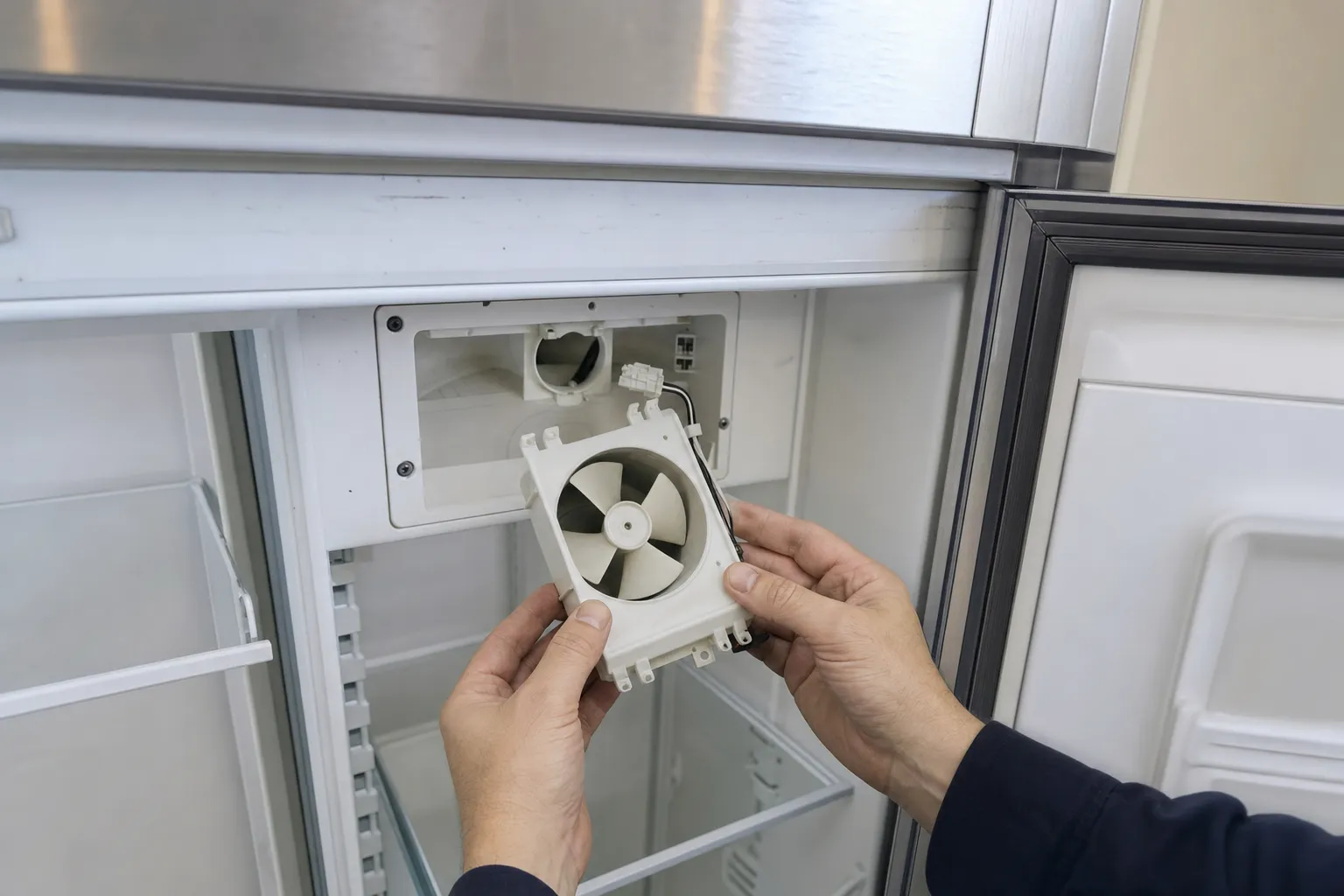
A fresh-food compartment drifting into the high forties while the freezer stays rock solid is almost never a dying compressor — that combination points at the fresh-food evaporator icing over, a stalled evaporator fan, or a defrost circuit that has stopped terminating properly. A compressor that barely stops, with warm air coming off the base grille, is a heat-rejection problem: a condenser packed with dust and pet hair, or a condenser fan turning slower than it should.
A service light that comes straight back after a proper clean is where the manufacturer’s own troubleshooting stops the owner: switch the unit off, check the condenser area is clean, switch it back on, and if the light is still showing, that is the point to call rather than to keep resetting it. What it usually means in practice is that the restriction is somewhere you cannot see from the front, or the condenser fan is turning slowly. And water collecting under the crisper drawers and freezing into a sheet is defrost meltwater with nowhere to go: the trough or the drain line is blocked.
The evidence, in the order we look at it
Nothing gets ordered until the whole cabinet has been read, and the order is fixed because each step decides whether the next one matters.
First, before anything is dismantled: what is each compartment actually holding against a thermometer on the shelf, is the compressor cycling at all, and what does the base grille air feel like. Second, grille off — condition of the condenser, and whether the fan is stopped, commanded and slow, or not commanded. Third, stored faults and sensor values in service mode, compared against the shelf reading rather than trusted on their own.
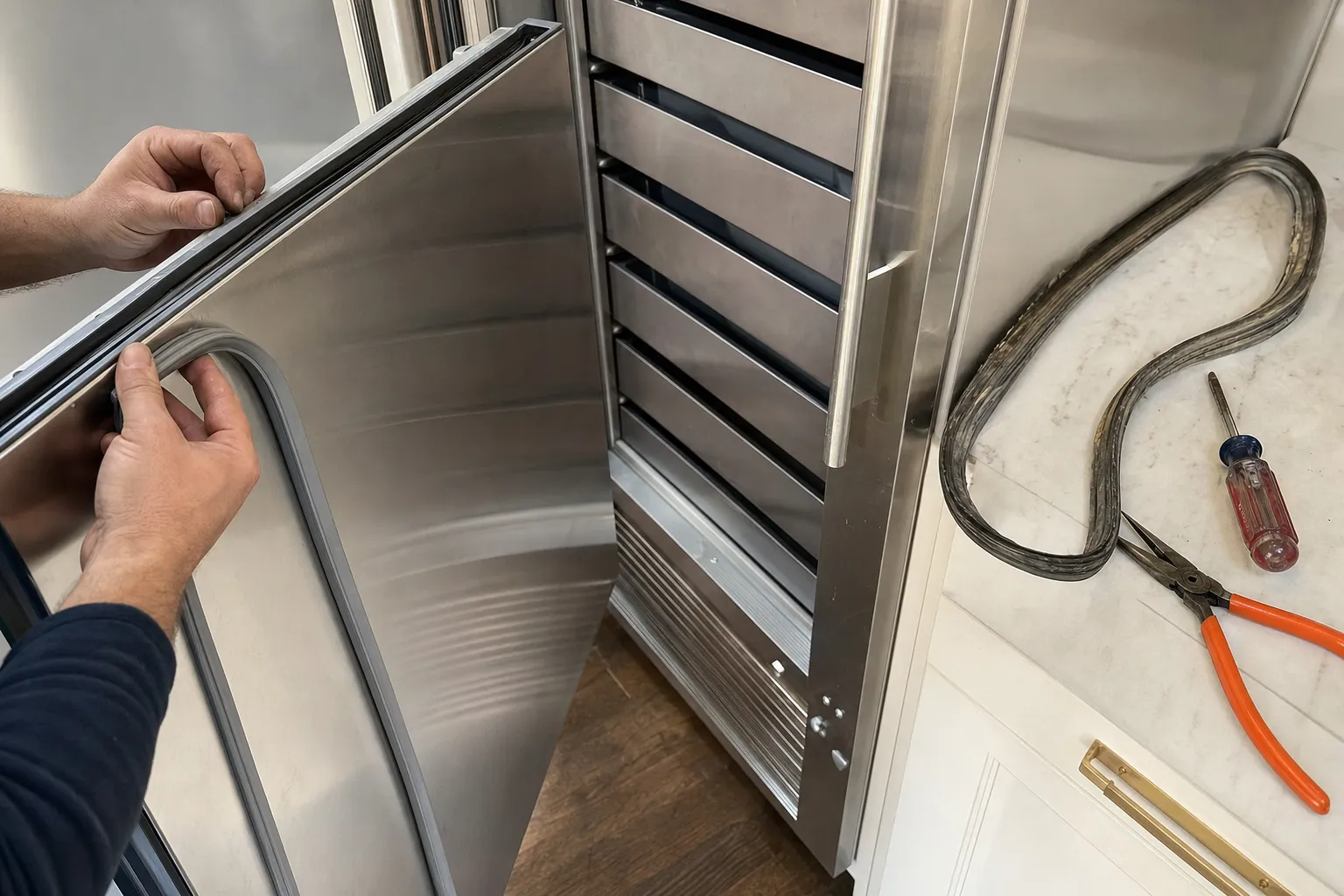
Fourth, the evaporator itself: rear panel off, read the ice pattern, spin the fan blade by hand, check the defrost heater for continuity, check the terminator, and prove the drain path with water rather than by eye. Fifth, if only one compartment is off, the air damper, the door closure and the gasket line get checked before anything electronic is blamed. Only then, sixth, do gauges come out — when the frost line on the suction and the temperature split across the condenser say the charge is genuinely short.
By the time the diagnostic is finished, the parts list includes the small items that only reveal themselves once the cabinet is open. That is the whole point of doing it in that order.
The fix that holds
A repair that holds on this island is one that anticipates its own companions. Sealed-system work is planned with the filter-drier, the process valve, the gaskets and the fasteners that get sacrificed on the way in, all carried in advance rather than discovered halfway through. Panel-ready columns and undercounter wine storage around Lynwood Center add their own hardware — hinge shims, panel brackets, toe-kick fixings — and those travel with us too.
The diagnosis is a flat $89, taken off the repair if you go ahead. Every repair page on this site prints the range for its own work, and the figure for your unit is written down before anything is ordered.
When two or three island jobs land in the same window we put them on one sailing rather than running them as separate trips. That is not a scheduling nicety. It is the only way the economics of a boat-served route stay reasonable for the people on it.
Where to stop and call
Stop and book when the fresh-food side has been climbing for more than a few hours while the freezer holds, when the base grille air is warm and the compressor will not rest, when a condenser message returns after a proper cleaning, or when meltwater is freezing under the drawers. Those are all faults that get more expensive the longer they run — a defrost problem that ices an evaporator solid eventually costs a fan motor as well.
Out at Port Madison and along the bluff drives above Rolling Bay, an early slot is worth asking for, simply because those addresses are furthest from the terminal at the end of a day. Call (206) 785-2960 with the model number in front of you. That is what lets the van leave the mainland already carrying the answer. How an island visit is planned, and the other questions people ask about the boat, are answered short on Island Answers.
Follow-ups we get on this one
- How long does a Sub-Zero repair take if you have to come from Seattle?
- The crossing itself is thirty to thirty-five minutes; the vehicle line before a busy sailing is the part nobody controls. That is why the diagnosis is finished on the first visit and the likely companion parts are packed before it. The jobs that need a second crossing are usually sealed-system repairs waiting on a part made for one model.
- Is it worth repairing a twenty-year-old built-in on Bainbridge Island?
- Usually yes. These cabinets are built around a serviceable sealed system, and the joinery in most island kitchens was made for the unit's exact opening, so replacing it means carpentry as well as an appliance. Defrost and fan repairs sit at the low end of the ranges on the repair pages; sealed-system work is the one worth weighing carefully.
- Can I clean the condenser myself to avoid a call-out?
- Yes, and you should. Switch the unit off, take the grille off, and brush and vacuum the coil along its fins, then put the grille back. If a service or condenser light comes straight back on a clean coil, stop there: the restriction is somewhere you cannot see from the front, or the condenser fan is turning slowly, and both are ours.
access ferrybainbridge islandlocal