Older-Unit Care · Salt
Old Door Gaskets in Damp Air: Cleaning, Testing, Knowing When They're Done
Damp marine air settles in the folds of an older Sub-Zero gasket, and a fold that never dries is where the seal starts to fail.
- Written by
- Bjorn Aaltonen
- Trade
- Refrigeration technician, 15 yrs
- Holds
- EPA 608 certified
- Dated
How the seal actually holds
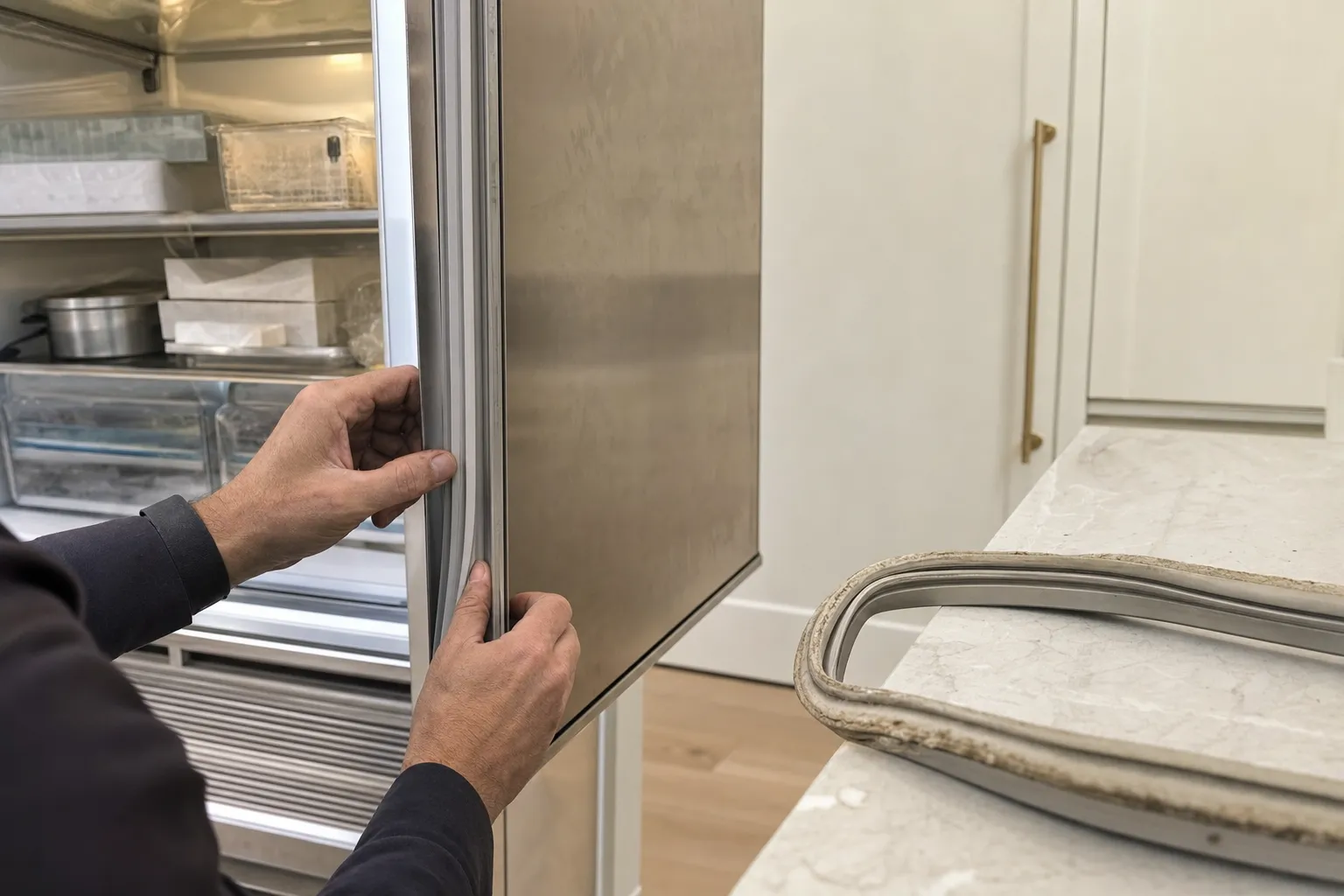
On the older 500 and 600 series the manufacturer’s guides describe four-sided magnetic gaskets: a strip of magnet runs inside the face of a soft rubber profile, and when the door swings shut the magnet pulls that face flat against the steel front of the cabinet. The folds behind the face are what let it do that. They flex so the gasket can meet the cabinet evenly all the way round, even where the door is not perfectly square to it.
That makes the folds the working part, and also the part nobody cleans. The drawing above shows where they sit and where the paper test goes.
What damp air does to the folds
A fold that stays wet collects everything the kitchen gives it: a drip of juice, crumbs, the film from a hand that was holding something greasy. Sub-Zero warns that sticky residue and spills left on a gasket lead to premature wear or cracking. In a dry climate the fold at least dries out between uses. Here, in a house near Eagle Harbor or on the Port Madison shore, the air stays damp through the winter, the residue stays soft, and mould finds it.
The rubber under a grimy fold can lose its give. Once it stops flexing back as the door closes, the face no longer lies flat and the magnet is holding the door against a gap. Warm, wet island air then moves in at that corner, and the first thing the owner notices is frost or water where it was never seen before.
Knowing when a gasket is done
Cleaning brings back a gasket that is merely dirty. It does not bring back one that has split. Sub-Zero’s rule is plain: a ripped, torn or cracked gasket should be replaced, and the replacement is work the manufacturer recommends leaving to a service technician. The same applies if the paper slides free at a corner that looks whole, because then the question is how the door hangs, which is not something to adjust with a screwdriver in the kitchen.
The procedure, step by step
- You will want
- Soft cloth or sponge · Dry towel · Flashlight · A strip of paper about the width of a banknote
- And to hand
- Lukewarm water with a little mild dish soap
-
Clear the door and look along all four sides
Take the jars off the door shelves so the door swings freely. Shine the flashlight along the gasket on every side, including the hinge edge you rarely see. You are looking for rips, tears, cracks, a section pressed flat, and black spotting deep in a fold.
-
Open each fold and wash it
Pull the outer lip back gently with a finger and wipe inside it with the cloth, lukewarm water and a little mild soap. Keep vinegar, rubbing alcohol and alcohol-based cleaners away from it: the current Classic guide rules them out on interior surfaces. Do not scrub a fold that is already splitting.
-
Dry the folds, not only the face
Wrap the dry towel over a fingertip and run it through every fold you washed. Water left in a fold on an island night is exactly the damp the page is about, so finish this before the door is shut again.
-
Make sure nothing is holding the door off the seal
Close the door slowly and watch the last few inches. A shelf, a crisper drawer or a tall bottle that catches it keeps the gasket off the cabinet no matter how good the rubber is. Sub-Zero's older 500-series guide asks owners to check exactly this.
-
Try the paper strip at four or five points
Close the door on the strip and draw it out, starting at the two top corners, then the bottom corners, then the middle of the handle side. A seal that is holding makes the paper drag. Where it slides out with no resistance, the seal is open at that point.
-
Write down which point failed and what it looked like
Note the corner, and whether the gasket there looked torn, flattened or perfectly whole. A whole gasket that still lets the paper go may be a door sitting slightly out of true rather than worn rubber, and telling those apart is a technician's job.
-
Leave a damaged gasket where it is
If you found a rip, a tear or a crack, the manufacturer's advice is to replace the gasket and to have a service technician fit it. Do not pull the old one off or trim it; leave it seated so the unit keeps what seal it has until the new one goes on.
That is where an owner stops. Past this point the work means panels off, live wiring or the sealed system, and it is ours: Driftwood Appliance Service, (206) 785-2960.