Freezer Repair
Sub-Zero Freezer Not Defrosting?
A freezer that is not defrosting and keeps building ice almost always has a failed defrost heater, sensor or control, or a frozen drain. Thaw it slowly with the power off, never chip at the coil, and have the parts tested if the frost comes back.
A freezer that keeps building ice has, in most cases, stopped defrosting itself. Every frost-free freezer, Sub-Zero included, melts the frost off its evaporator coil from time to time; when the heater that does the melting burns out, the sensor that ends the cycle fails, the control never starts it, or the drain that carries the meltwater away freezes shut, frost stacks up behind the rear panel until it smothers the airflow and the freezer starts drifting warm. The cure is a slow thaw with the power off, then a test of those parts if the ice comes back. On Bainbridge Island, where damp marine air rides in with every opening of the door, a dead defrost system makes itself obvious within days.
Where all that frost comes from
Frost is water that entered the freezer as vapor. Room air carries moisture, and when it touches the coldest surface in the cabinet, the evaporator coil, that moisture locks onto it as feathery crystals. It happens with every opening of the door or drawer, more so with warm leftovers or an uncovered tray of berries. Wet, mild island winters keep indoor air damper than in a dry inland climate, so a kitchen in Winslow or a waterfront house in Port Madison feeds the coil a steady supply. None of that is a fault: a healthy freezer expects it and clears it before it builds. Ice that keeps accumulating means either far more humid air is getting in than the design allows, or the system that removes it has quit.
How the automatic defrost is meant to work
Behind the back panel sits the evaporator, a coil of thin tubing and fins, with a fan that pushes air across it. At intervals the control pauses cooling and powers a defrost heater fixed against the coil. A sensor or thermostat clipped to the tubing tracks its temperature and ends the cycle once the frost has gone. Meltwater drips into a trough, runs down a drain tube and collects in a pan near the compressor, where warm air off the condenser evaporates it. Break any link in that chain and each new layer of frost lands on top of the last. Our page on the defrost circuit in a freezer drawer follows each part in more detail.
Reading the ice before you touch it
Where the ice sits says a good deal about why it is there.
| What you see | What it usually points to |
|---|---|
| Snowy frost on the back wall or vent cover, shelves clear | Defrost heater, sensor or control |
| Frost along the door or drawer edge and on the front of packages | Gasket not sealing, or a door left ajar |
| A clear glaze of ice on the compartment floor | Frozen drain, or an overfilling ice maker |
| Ticking or scraping from the back, food softening | Ice has reached the fan blades |
Frost confined to the rear panel is the textbook sign of a defrost failure. Frost near the opening is about air getting in, and a glassy sheet underneath is about water ending up somewhere it should not.
Simple checks you can make first
- Trap a slip of paper in the seal along the top, each side and the bottom, then tug it loose. Each test should resist a little; a slip that falls free marks a gap letting damp air in.
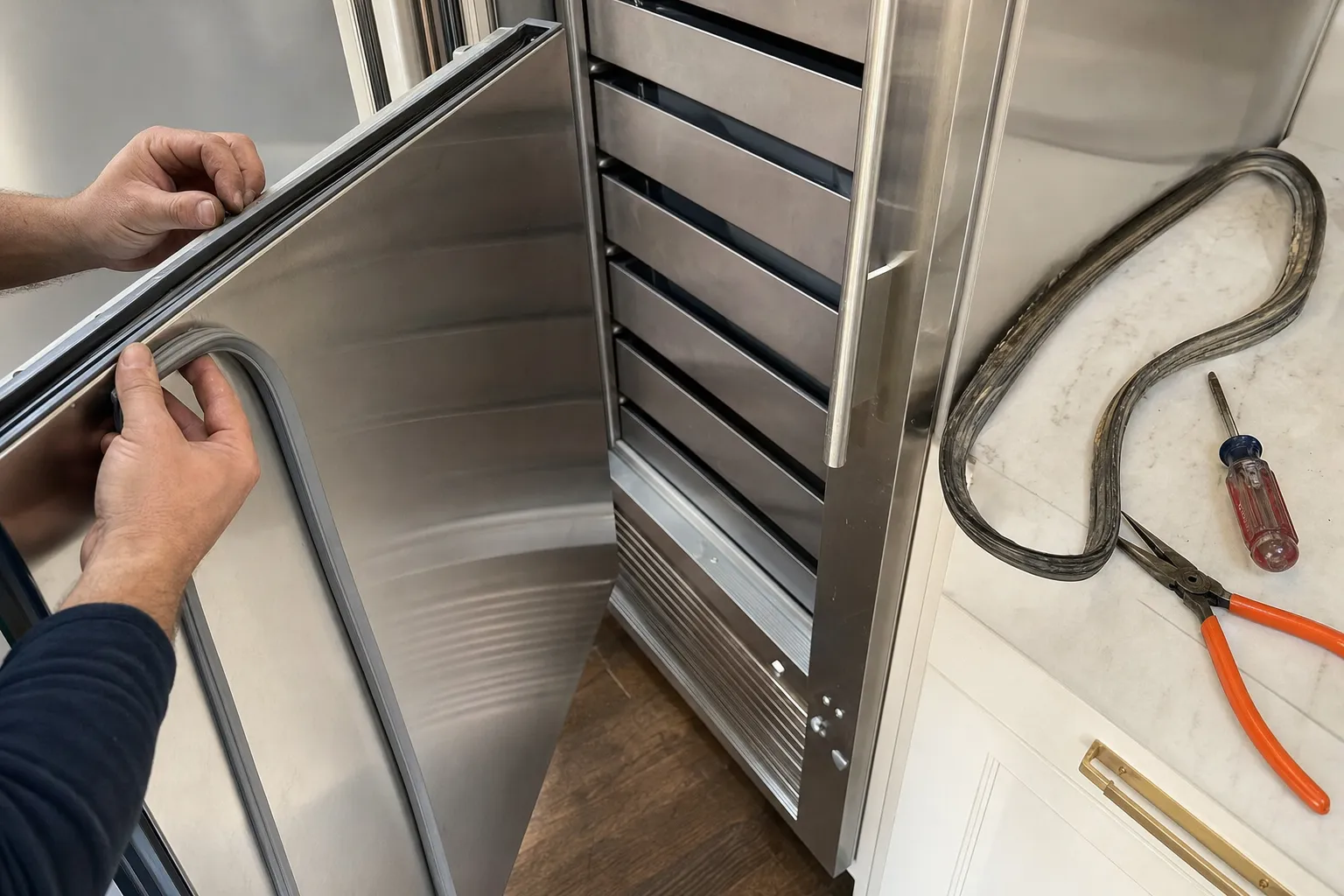
- Wash the gasket with warm, mildly soapy water and dry it. A folded, sticky or torn section will not seal.
- Make sure nothing, from a bag corner to a shelf pushed too far back, holds the door or drawer a hair open.
- See whether Sabbath Mode is on. On a Sub-Zero it silences the door chime and idles the ice maker while engaged, and a power cut does not cancel it, so an open door can sit unnoticed for hours.
Thawing it out the slow way
A full manual thaw clears the ice and doubles as a diagnosis. Move the food into coolers with ice packs, switch the freezer off at its control or the breaker, and leave it open with thick towels on the compartment floor and along the toe of the cabinet. A fan blowing room air inside speeds the melt, as do bowls of warm water on a shelf. A heavily iced coil can take most of a day. Mop as you go, then dry the liner, restart, and reload only once it is cold again. Mark the date: snow creeping up the back wall within a week or two means the defrost system has failed. A power cut calls for a slightly different routine; see bringing a unit back after a windstorm outage.
Why chipping at the ice costs far more than it saves
Ice on the back wall looks as though it rests on plastic, but it is often frozen onto the evaporator itself, and the tubing in that coil is thin enough for a knife tip, screwdriver or ice pick to pierce in a single jab. A punctured coil lets the refrigerant out and the freezer warms for good. That turns a defrost part, typically $290–$640 after diagnosis, into a compressor or sealed-system job in the $1,340–$3,120 range. Liners crack as well, letting meltwater soak into the insulation where it cannot be dried. A hair dryer or heat gun brings different trouble: it can warp the plastic, and it puts a live tool beside running water. Towels, a fan and patience cost nothing.
When the ice maker is the real source
A clear slab of ice in the bin or on the freezer floor may come from the water side. When a cube jams or the fill valve sticks, water keeps coming and freezes where it lands. Sub-Zero controls flag this:
- On a Classic built-in, a lone flashing ice cube icon with no chime says the fill valve ran too long and the control locked the ice maker out. Once the water line checks out, hold Alarm until CFC appears.
- On a 600 Series, error code 30 flags the valve solenoid running more than 15 seconds, 5 times. Clear any jammed cube first.
- A Classic showing 30 8 05 needs the freezer at or below 0°F and no cubes stuck in the mold, then 30 seconds with the breaker off.
What the repair usually involves
Most frost faults trace back to a short list of parts. Typical ranges on the island, with the firm figure only after testing:
- A failed heater, sensor or thermostat in the defrost circuit runs $290–$640
- A fan motor at the evaporator or condenser runs $310–$700
- A new door gasket runs $280–$640
- A replacement control board runs $430–$890
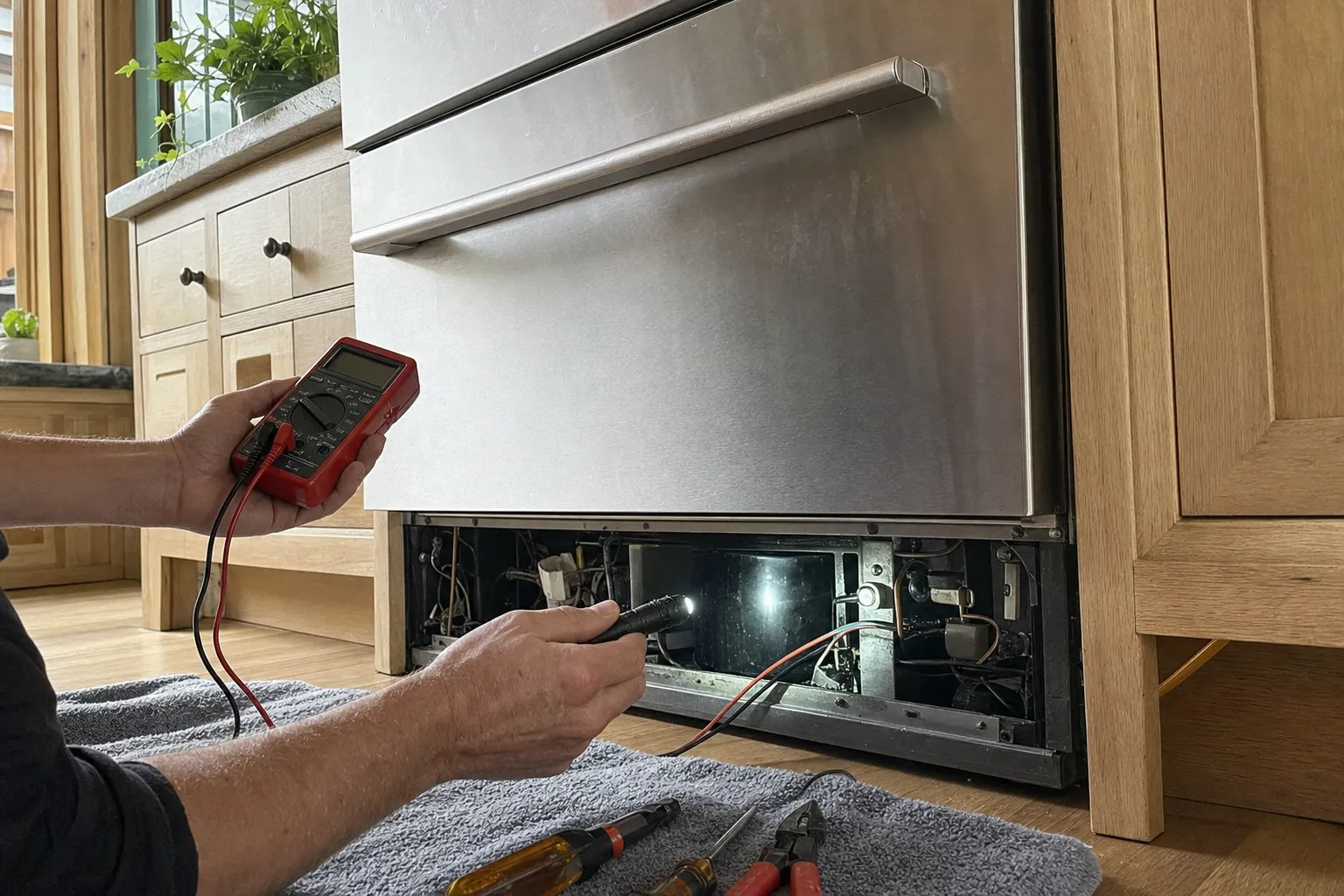
On a frosted freezer the $89 visit goes on proving which link failed, testing heater continuity, the cut-off sensor and the drain before a part is named; go ahead with the work and the $89 is folded into it rather than added on top. Driftwood Appliance Service covers Winslow, Rolling Bay, Lynwood Center and Port Madison at (206) 785-2960; see Sub-Zero freezer repair on the island.
Follow-ups we get on this one
- Is a thick layer of ice in the freezer actually a problem?
- Yes, once it is more than a light dusting it works against you. Ice on the coil blocks the air that carries cold into the compartment, so the freezer runs longer and still drifts warm, and heavy frost can reach the fan blades and stall them. It also tells you that either humid air is getting in or the defrost system has quit, and neither fixes itself.
- What happens if the ice is simply left to keep growing?
- The freezer slowly loses its grip on temperature. As the coil vanishes under ice, less air passes through it, the compressor runs almost without a break, ice cream softens and meat starts to thaw at the edges. Eventually the fan locks in the ice and cooling all but stops, often with a full load of food inside.
- Why is the refrigerator side warm when the freezer is the one full of ice?
- On many fridge-freezers the fresh-food side is cooled by air borrowed from the freezer coil, so an iced coil starves the refrigerator first. Many Sub-Zero built-ins give each compartment its own cooling system instead; on those, a warm refrigerator next to an iced freezer usually means two separate faults, and both deserve a look in the same visit.
- Can the ice be cleared without switching the freezer off?
- Only a thin skin near the door, which a soft plastic scraper can lift without harm. Frost on the back wall sits on or right beside the evaporator coil, and loosening it while the unit runs means working with tools near thin refrigerant tubing. Switch off, thaw with towels and room air, and nothing gets punctured.
- What does a defrost system repair usually cost?
- A defrost heater, thermostat or sensor typically falls in the $290–$640 range, with the firm price given once the fault is confirmed. If the control board turns out to be the cause the typical range is $430–$890 instead. The $89 visit fee is credited toward whichever repair you approve.
freezerdefrostfrostice build-up